Navigating the CAA Open Category: Comprehensive Guidance for European Drone Pilots
Navigating the CAA Open Category: Comprehensive Guidance for European Drone Pilots
When flying drones in Europe, understanding the regulatory framework is critical to staying safe, compliant, and avoiding penalties. The Open Category, overseen by the European Union Aviation Safety Agency (EASA), provides a structured set of rules for drone pilots operating in low-risk scenarios. Whether you're capturing aerial photography, conducting inspections, or simply flying for recreation, this guide will walk you through everything you need to know about Open Category operations.
At 120mAGL.com, we specialize in making European drone regulations accessible and actionable. This guide covers the key aspects of Open Category operations, offering practical tips, real-world examples, and step-by-step instructions to help you fly legally and safely.
What is the Open Category?
Overview and Background
The Open Category is one of three operational categories defined by EASA under Regulation (EU) 2019/947. It applies to drone flights that are deemed low-risk, meaning they do not require prior authorization from the aviation authority. Instead, pilots must follow a set of pre-defined operational rules to ensure safe and responsible flying.
The Open Category was introduced to simplify compliance for drone operators conducting straightforward operations, such as recreational flights, aerial photography, or basic inspections. These rules aim to balance innovation in drone technology with safety for other airspace users and the general public.
Why Does the Open Category Exist?
- ▸Safety First: By setting clear operational limits, the Open Category minimizes risks to people and property on the ground and in the air.
- ▸Accessibility: The rules make it easier for individuals and businesses to start using drones without the complexity of obtaining specific permissions.
- ▸Scalability: The category supports the growing adoption of drones while maintaining high safety standards across Europe.
Understanding Open Category Subcategories
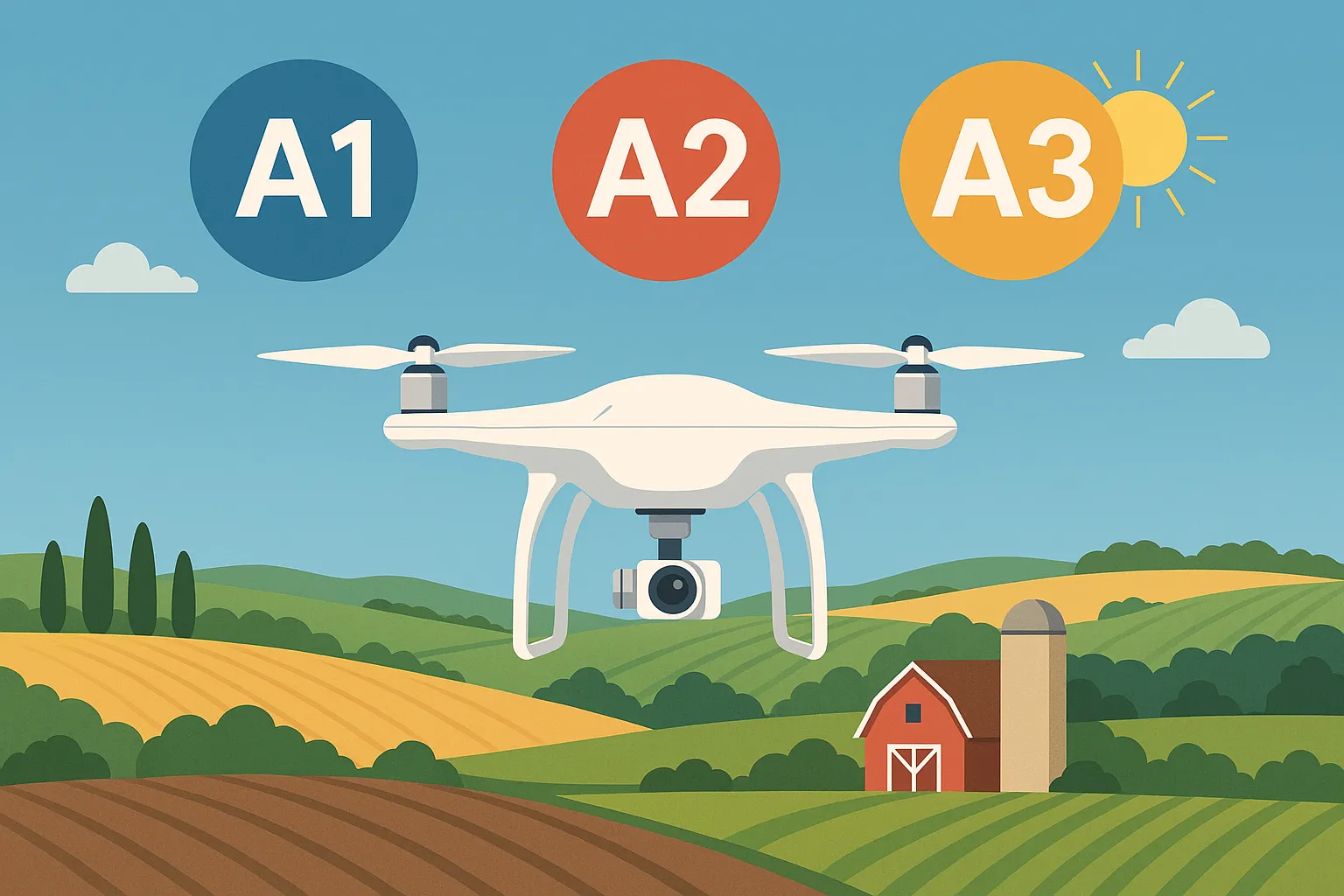
The Open Category is divided into three subcategories: A1, A2, and A3, based on the type of drone, its weight, and where it will operate. Each subcategory has specific requirements:
Subcategory A1: Flying Over People
- ▸Drone Weight: Less than 250g or certified as C0 or C1 class.
- ▸Proximity Rules: Flying over people is permitted but never over crowds.
- ▸Example: A recreational pilot flying a DJI Mini 3 over a park with scattered individuals.
Subcategory A2: Flying Near People
- ▸Drone Weight: Between 250g and 2kg (C2 class drones).
- ▸Proximity Rules: Maintain a horizontal distance of at least 30 meters from uninvolved people. If the drone has a "low-speed mode," this distance can be reduced to 5 meters.
- ▸Training Requirement: Complete a theoretical knowledge exam (A2 Certificate of Competency).
- ▸Example: A real estate photographer using a DJI Air 3 to capture aerial images of a property in an urban area.
Subcategory A3: Flying Far From People
- ▸Drone Weight: Between 2kg and 25kg (C3 or C4 class drones).
- ▸Proximity Rules: Operate in areas where no uninvolved people are present. Maintain at least 150 meters from residential, industrial, and recreational areas.
- ▸Example: A farmer using a drone for crop monitoring in a rural field.
Detailed Requirements for Open Category Operations
General Rules for All Subcategories
To fly in the Open Category, you must meet the following requirements:- ▸Maximum Altitude: Flights must not exceed 120 meters above ground level (AGL), except in specific cases where permission is granted or when flying within 120 meters of a structure (Reg 2019/947 Art. 4).
- ▸Visual Line of Sight (VLOS): The drone must always remain within the pilot's line of sight (Reg 2019/947 Art. 4).
- ▸No Autonomous Operations: The drone must be under direct control of the remote pilot (Reg 2019/947 Art. 4).
- ▸Flight Restrictions: Flying over assemblies of people is prohibited unless operating under A1 subcategory rules (Reg 2019/947 Art. 5).
Drone Marking and Certification
- ▸Drones must be CE-marked and classified into one of the five classes (C0 to C4) under Regulation (EU) 2019/945. Ensure your drone has the correct label and meets the specifications for its class (Reg 2019/945 Art. 4).
Age and Registration Requirements
- ▸Pilots must be at least 16 years old to operate drones in the Open Category (Reg 2019/947 Art. 5).
- ▸All drones weighing 250g or more, or equipped with a camera, must be registered with the national aviation authority (Reg 2019/947 Art. 14).
Practical Application: Flying in the Open Category
Step-by-Step Compliance Guide
- ▹Avoid no-fly zones, such as airports or restricted airspace.
- ▹Conduct a risk assessment for your intended operation.
- ▹Maintain a maximum altitude of 120 meters AGL.
- ▹Keep the drone within your visual line of sight.
- ▹Respect proximity rules for uninvolved people and structures.
- Identify Your Subcategory: Determine whether your operation falls under A1, A2, or A3 based on drone weight and proximity to people.
- Check Your Drone's Classification: Verify that your drone is CE-marked and classified correctly (C0 to C4).
- Complete Required Training: If flying in A2, obtain the A2 Certificate of Competency by passing the theoretical exam.
- Register Your Drone: Register with your national aviation authority if required.
- Plan Your Flight:
- Fly Within Legal Limits:
Real-World Example: A Photographer's Aerial Shoot
Imagine a photographer using a DJI Mini 3 Pro for a wedding shoot. They plan to operate in a park with small groups of guests. Since the drone is under 250g and falls under A1, they can legally fly over people but must avoid large crowds. They ensure their flight remains under 120 meters AGL and within their visual line of sight.Common Questions and Challenges
Q1: Can I fly over a crowd if my drone is under 250g?
No, even in A1, flying over crowds is prohibited to ensure safety (Reg 2019/947 Art. 4).Q2: What happens if my drone loses connection during flight?
Pilots must ensure their drone is equipped with a return-to-home (RTH) feature to automatically land safely in case of signal loss.Q3: Do I need insurance to fly in the Open Category?
While not always mandatory, liability insurance is strongly recommended to cover potential damages caused by your drone.Q4: What are the penalties for flying outside the Open Category limits?
Violations can result in fines, confiscation of equipment, or even criminal charges depending on the severity of the infraction.Compliance Checklist
Use this checklist before every flight:
- ▸[ ] Drone is CE-marked and classified (C0-C4).
- ▸[ ] Registration completed for drones ≥250g.
- ▸[ ] Training completed (A2 Certificate if applicable).
- ▸[ ] Flight plan avoids no-fly zones and restricted areas.
- ▸[ ] Maximum altitude of 120 meters AGL maintained.
- ▸[ ] Drone remains within visual line of sight.
- ▸[ ] Proximity rules for people and structures followed.
Case Studies
Case Study 1: Recreational Flying in A3
A hobbyist operates a DJI Phantom 4 in a rural area, ensuring no uninvolved people are present and maintaining 150 meters from buildings. This operation is compliant under A3 rules.Case Study 2: Commercial Inspections in A2
A construction company uses a DJI Air 3 to inspect a site near an industrial area. The drone operator maintains a 30-meter distance from workers, adhering to A2 proximity rules.Key Takeaways
- ▸Always know your subcategory (A1, A2, or A3) before flying.
- ▸Stay below the 120m AGL limit for safety and compliance.
- ▸Register your drone and complete training where required.
- ▸Conduct risk assessments and plan flights responsibly.
- ▸Follow proximity rules to protect uninvolved people and property.
Frequently Asked Questions
Q1: Can I fly near airports in the Open Category?
No, all flights must avoid restricted airspace, including near airports (Reg 2019/947 Art. 4).Q2: How do I know if my drone is classified correctly?
Check for the CE marking and class identification label on your drone (Reg 2019/945 Art. 4).Q3: Can I fly at night in the Open Category?
Yes, but ensure the drone is equipped with lights for visibility and safety.Conclusion
The Open Category provides a straightforward way for drone pilots to operate legally and safely across Europe. By understanding the subcategories, following the rules, and planning flights responsibly, you can unlock the full potential of your drone while minimizing risks to others.
At 120mAGL.com, we’re committed to helping you navigate EASA regulations with confidence. Bookmark this guide and check back regularly for updates. Stay safe, fly responsibly, and always operate within the 120-meter altitude limit.
References
- ▸Regulation (EU) 2019/947: Link to official EASA documentation
- ▸Regulation (EU) 2019/945: Link to official EASA documentation
Reminder: Regulations may change. Always consult official EASA sources for the latest information. For more detailed guides, visit 120mAGL.com . Fly safe!

About the Author
Roberto Gramellini
Aviation expert and UAS regulations specialist with extensive experience in EASA compliance and drone operations. Passionate about making complex regulations accessible to drone pilots across Europe.
EASA Regulatory Compliance Notice
This content is for educational purposes only and is based on EASA regulations current at the time of generation.
Always consult the official EASA documentation and your local aviation authorities for the most current regulations and legal compliance requirements before operating any UAS.